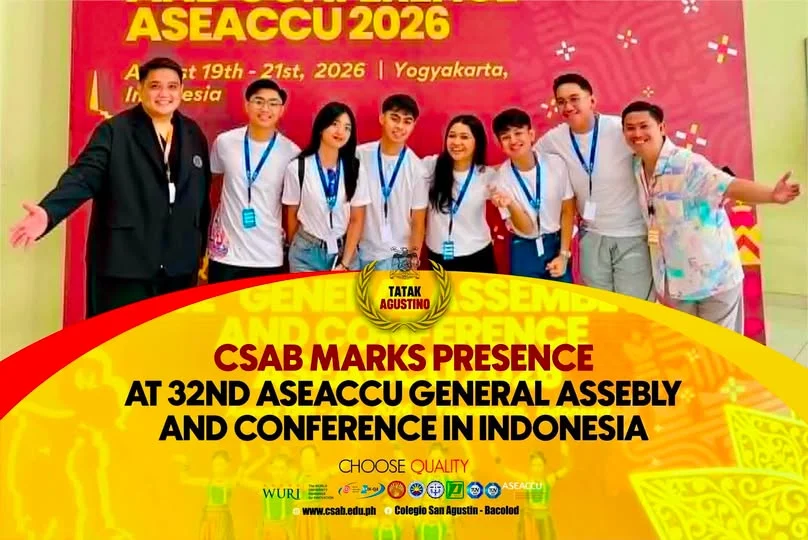
Colegio San Agustin-Bacolod joined Catholic higher education institutions from across Southeast and East Asia at the 32nd Association of Southeast and East Asian Catholic Colleges and Universities (ASEACCU) Annual Conference, held in Yogyakarta, Indonesia.
Co-hosted by Universitas Atma Jaya Yogyakarta and Universitas Sanata Dharma, the conference brought together higher education leaders, educators, and representatives of Catholic colleges and universities across the region under the theme, “Education, Hope, and Human Flourishing: Fostering Intercultural Encounter and Dialogue.”
Representing CSAB were Fr. Manuel Vergara, OSA, Associate Vice President for Academic Affairs and Dean of the College of Accountancy, Business Education and Computer Studies; Fr. Ian Geoffrey Kasilag, OSA, Chaplain/Campus Minister and Assistant Vice President for Student Affairs and Welfare; Mr. Plaridel Tison, Jr., Student Government Adviser; and student leaders representing various colleges of the institution.
The CSAB delegation participated in plenary sessions, collaborative workshops, and intercultural dialogues, providing opportunities to engage with fellow Catholic higher education institutions and exchange perspectives on emerging challenges, opportunities, and transformative approaches in education.
CSAB’s participation in ASEACCU 2026 also served as a valuable platform for strengthening its international academic network, fostering institutional partnerships, and broadening opportunities for collaboration with Catholic higher education institutions across the region.
Beyond the conference sessions, CSAB’s presence at ASEACCU 2026 underscored the institution’s commitment to active participation in the wider Catholic higher education community and to cultivating meaningful relationships across cultures and borders. Through such engagements, CSAB continues to advance its vision of becoming a more globally connected institution while remaining rooted in its Catholic and Augustinian identity.